T1 Crossover Cable
See also: crossover T1 cable
Two devices with PRI interfaces can be connected together with a PRI crossover or null-modem cable.
It should be emphasized that while a common ethernet patch cord can by used just fine for a PRI patch cord (they are both 4 pair RJ45 straight thru's), the different signal assigments suddenly matter when building a crossover. Therefore the "Ethernet Crossover Cable" can NOT (:eek:) be used as a substitute for a "PRI crossover".
What's more, the PRI crossover cable seems to be a pretty rare item. Most places you ask for it will hear the words "cross over cable" and ask a few times if you want an ethernet x-o. Just say no! (:frown:) You will probably just end up rolling your own. (:wink:)
I avoid crimping my own cables and being left doubting their integrity, so I use regular patch cords but built a F/F cross over box using a 2 port RJ45 housing. IMHO, jacks in a box (:rolleyes:) are easier to handle, see, label, verify, correct and change. It also allows for easier cable swapping for diagnosis and for length and color changes.
For those using a 586A wall type box, here is a picture of a working one wired for a T1 crossover:
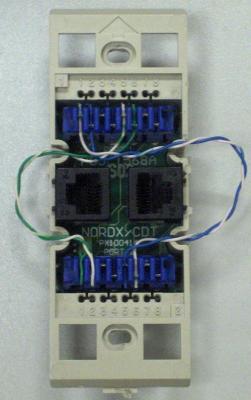
WARNING, I believe this image is incorrect, this image is 1,6 2,5 6,1 5,2 ...
all other documentation states 1,4 2,5 5,1 6,2
Two devices with PRI interfaces can be connected together with a PRI crossover or null-modem cable.
It should be emphasized that while a common ethernet patch cord can by used just fine for a PRI patch cord (they are both 4 pair RJ45 straight thru's), the different signal assigments suddenly matter when building a crossover. Therefore the "Ethernet Crossover Cable" can NOT (:eek:) be used as a substitute for a "PRI crossover".
What's more, the PRI crossover cable seems to be a pretty rare item. Most places you ask for it will hear the words "cross over cable" and ask a few times if you want an ethernet x-o. Just say no! (:frown:) You will probably just end up rolling your own. (:wink:)
I avoid crimping my own cables and being left doubting their integrity, so I use regular patch cords but built a F/F cross over box using a 2 port RJ45 housing. IMHO, jacks in a box (:rolleyes:) are easier to handle, see, label, verify, correct and change. It also allows for easier cable swapping for diagnosis and for length and color changes.
For those using a 586A wall type box, here is a picture of a working one wired for a T1 crossover:
WARNING, I believe this image is incorrect, this image is 1,6 2,5 6,1 5,2 ...
all other documentation states 1,4 2,5 5,1 6,2


Comments
333Are the pins right? 12 56? Really?
333
333Like the box... how do you make it?
333Channel banks hooked to Digium T1